The Einstellung Rigidity Index
AI models that learn one task after another can cling to an early shortcut. ERI measures how long, and what it costs.
IEEE ICBAIE 2025

A 4 × 4 magenta square, top left, on every image of five classes.At test time the square is overwritten with neutral pixels.
Accuracy on the five patched classes
Continual methods
Baselines
The Einstellung Rigidity Index (ERI) is my first-author paper for IEEE ICBAIE 2025, written with Prof. Weishi Shi at UNT’s Active Machine Learning Lab. It measures how long a continual-learning model keeps relying on a shortcut after the shortcut stops helping. We plant a small magenta patch on some CIFAR-100 classes, mask it at test time, and score each method on three numbers. Our PyTorch pipeline benchmarked seven or more continual-learning methods.
Before you read
Try Luchins’s water jars
Nine short problems, each with up to three jars and an amount to measure. Pour a jar into the basin to add its amount, or fill the jar from the basin to take its amount out.
The paper
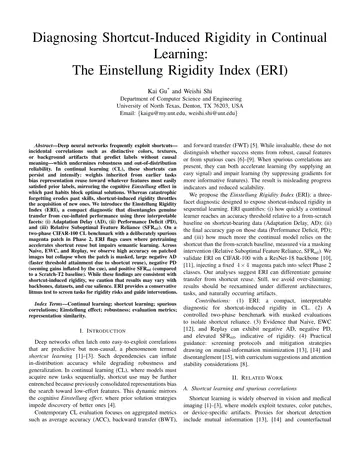
Diagnosing Shortcut-Induced Rigidity in Continual Learning: The Einstellung Rigidity Index (ERI)
Abstract
Deep neural networks frequently exploit shortcuts—incidental correlations such as distinctive colors, textures, or background artifacts that predict labels without causal meaning—which undermines robustness and out-of-distribution reliability. In continual learning (CL), these shortcuts can persist and intensify: weights inherited from earlier tasks bias representation reuse toward whatever features most easily satisfied prior labels, mirroring the cognitive Einstellung effect in which past habits block optimal solutions. Whereas catastrophic forgetting erodes past skills, shortcut-induced rigidity throttles the acquisition of new ones. We introduce the Einstellung Rigidity Index (ERI), a compact diagnostic that disentangles genuine transfer from cue-inflated performance using three interpretable facets: (i) Adaptation Delay (AD), (ii) Performance Deficit (PD), and (iii) Relative Suboptimal Feature Reliance (SFRrel). On a two-phase CIFAR-100 CL benchmark with a deliberately spurious magenta patch in Phase 2, ERI flags cases where pretraining accelerates shortcut reuse but impairs semantic learning. Across Naive, EWC, and Replay, we observe high accuracy on patched images but collapse when the patch is masked, large negative AD (faster threshold attainment due to shortcut reuse), negative PD (seeming gains inflated by the cue), and positive SFRrel (compared to a Scratch-T2 baseline). While these findings are consistent with shortcut-induced rigidity, we caution that results may vary with backbones, datasets, and cue salience. ERI provides a conservative litmus test to screen tasks for rigidity risks and guide interventions.
Where the name comes from
Einstellung is a human habit before it’s a machine one. In the Luchins water-jar experiment (1942), people who had solved many puzzles with the same method kept applying it to later puzzles, even when a simpler solution existed. Past success made them worse at the new problem.
Continual-learning models can fall into the same trap. A network that learns tasks one after another can pick up a shortcut early, some feature that happens to predict the label, and keep leaning on it after it stops being useful. ERI is a diagnostic for that kind of rigidity.
The experiment
We made the shortcut on purpose. A 4 by 4 magenta square goes into the top-left corner of every image from five CIFAR-100 classes, so a model can learn to spot the patch instead of the object. Then we mask the patch at test time and watch what each method does without it.

What is real here
From the paper: CIFAR-100 images are 32 × 32 pixels. A 4 × 4 magenta square sits in the top left of every image of five classes, and at test time it is overwritten with neutral pixels. So the patch starts top left, moves in whole pixels of the 32, and turns grey when masked.
Drawn for this page: the apple, which is not an image from the dataset; where the model looks; and how fast its gaze moves. The paper measures accuracy with and without the patch and draws no attention maps. Masking there is a test of a trained model, not something it recovers from: with the patch masked, the highest accuracy on the patched classes in Table I, a mean of four seeds, was 0.009.
The protocol runs in two phases. In Phase 1 a ResNet-18 learns a first set of CIFAR-100 superclasses from natural images. In Phase 2 it learns new superclasses, and five of the new classes carry the patch. At test time we overwrite the patch with neutral pixels.
Rather than one score, ERI splits rigidity into three numbers: adaptation delay, performance deficit and shortcut reliance. The pipeline benchmarked seven or more continual-learning methods. The paper reports three of them, naive fine-tuning, EWC and Replay, each against a model trained only on Phase 2 (Scratch-T2) and one trained on both phases together (Interleaved).
I built the two-phase protocol and the PyTorch pipeline that runs it. The pipeline extends Mammoth, an open-source continual-learning framework built on PyTorch.
What we found
On images with the patch, every continual method looked better than a model trained from scratch. Naive fine-tuning, EWC and Replay reached 0.6 accuracy 14 epochs sooner than Scratch-T2, on the two seeds where Scratch-T2 reached it at all, and finished 0.144 to 0.156 higher. Then we masked the patch, and their accuracy on those classes fell to 0.009 or less.
That is the pattern ERI flags: a negative adaptation delay, a negative performance deficit and a positive shortcut reliance. The speed and the gains came from the patch. Compared with Scratch-T2, the continual methods relied on it more, by 0.142 to 0.155.
The same models scored 0.664 to 0.674 on the new classes without a patch, so they could learn real features when no shortcut was there. They also kept nothing of Phase 1 (0.000), where Interleaved training kept 0.329.
The paper is careful about scope. The cue is synthetic and high-contrast, we used one backbone and one patch location, and we ran four seeds, so the effect may differ with natural artifacts and larger models.
ADAdaptation delay, epochs
Below zero: reached 0.6 accuracy sooner than Scratch-T2.
PDPerformance deficit
Below zero: finished higher than Scratch-T2 on patched images.
SFRrelRelative shortcut reliance
Above zero: lost more than Scratch-T2 when the patch was masked.
Table I from the paper, in full
| Strategy | AD | PD | SFRrel | Patched classes, with patch | Patched classes, masked | Phase 1 classes | Unpatched Phase 2 classes |
|---|---|---|---|---|---|---|---|
| Scratch-T2 | N/A | N/A | 0.000 | 0.586 | 0.000 | N/A | 0.617 |
| Interleaved | −6.00 | −0.089 | 0.093 | 0.679 | 0.000 | 0.329 | 0.353 |
| Naive | −14.0 | −0.144 | 0.142 | 0.730 | 0.002 | 0.000 | 0.664 |
| EWC | −14.0 | −0.156 | 0.146 | 0.742 | 0.009 | 0.000 | 0.674 |
| Replay | −14.0 | −0.156 | 0.155 | 0.742 | 0.001 | 0.000 | 0.664 |
AD in epochs. The last four columns are accuracies. The paper names the methods Naive_Seq, EWC_Seq and Replay_Seq.
What came of it
The paper, “Diagnosing Shortcut-Induced Rigidity in Continual Learning: The Einstellung Rigidity Index (ERI),” is at IEEE ICBAIE 2025, with me as first author and Prof. Shi as coauthor. I presented it at UNT’s 3rd Annual University Research Day. My research in the lab, from September 2024 to May 2026, also earned the TAMS Summer Research Scholarship ($4,000) and the UNT Undergraduate Research Fellowship ($500).
Cite
@inproceedings{gu2025eri,
  title     = {Diagnosing Shortcut-Induced Rigidity in Continual Learning: The Einstellung Rigidity Index ({ERI})},
  author    = {Gu, Kai and Shi, Weishi},
  booktitle = {IEEE ICBAIE 2025},
  year      = {2025}
}- Built with
