Search⌘KLights off
Sam Gu

LinkedUp

LinkedIn, minus the bots. LinkedUp matches you on what your interests mean, then puts you both on a video call.
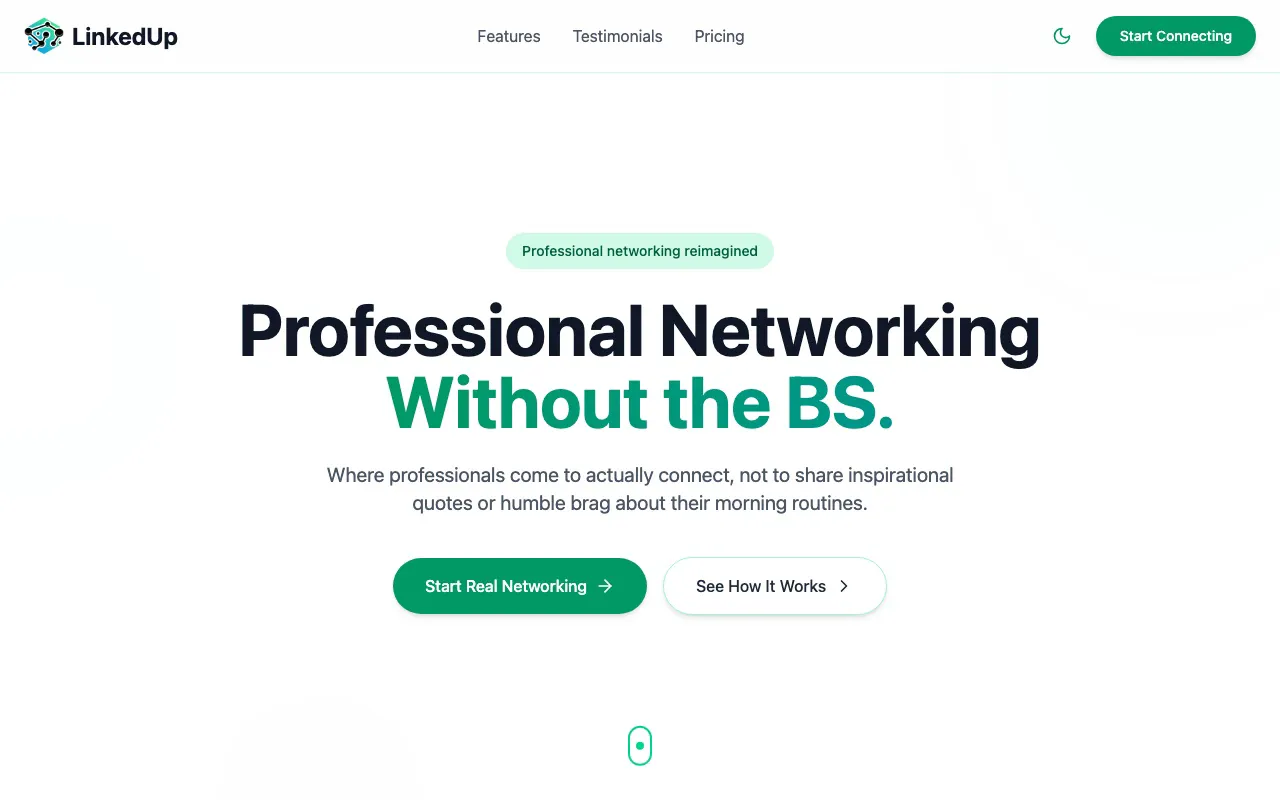
LinkedUp is networking without the feed. You pick your interests, and it puts you on a video call with the person whose interests mean the closest thing to yours, even when you each name them differently. Doing that live, with real calls, was the hard part. I led the five-person team, and we piloted it with more than 40 users.

Matching works on meaning

LinkedUp’s 18 sign-up interests, placed by meaning: the brighter a dot, the closer it is to the one you pick. The positions come from an open model run once for this page, not the OpenAI embeddings LinkedUp uses, so the app’s own numbers would differ.

Why we built it

We built it out of frustration with LinkedIn: cluttered screens, bots everywhere, and networking that rarely turned into a conversation. Our answer was blunt. Skip the message thread and put two people who should talk on a call.

What you get

LinkedUp’s 18 sign-up interests, placed by meaningA map of the 18 interests, closer meanings nearer each other: the tech interests together at the right, the arts at the lower right, the games at the top, sports and travel at the left. Drawing and Painting share no word but sit close, with a cosine similarity of 0.68.ProgrammingArtificial IntelligenceWeb DevelopmentDrawingPaintingDesignVideo GamesBoard GamesFitnessYogaRunningPlaying MusicSingingPhotographyBooksPoetryTravelingBackpackingDrawing and Painting: no shared word, 0.68LinkedUp’s 18 sign-up interests, placed by meaningA map of the 18 interests, closer meanings nearer each other: the tech interests together at the right, the arts at the lower right, the games at the top, sports and travel at the left. Drawing and Painting share no word but sit close, with a cosine similarity of 0.68.ProgrammingArtificial IntelligenceWeb DevelopmentDrawingPaintingDesignVideo GamesBoard GamesFitnessYogaRunningPlaying MusicSingingPhotographyBooksPoetryTravelingBackpackingDrawing and Painting: no shared word, 0.68
LinkedUp’s 18 sign-up interests, embedded with the open all-MiniLM-L6-v2 model as a stand-in for the OpenAI embeddings the app uses. They are laid out by their first two principal components, nudged apart only enough to read, and similar interests sit near each other even when their names share no word, which is why matching on meaning finds pairs that keywords miss.
  • A match on meaning, not keywords. Your interests become an OpenAI embedding stored in Postgres with pgvector, and the matcher pairs the closest ones.
  • A call, not a thread. Once you match, Stream opens a voice and video room for the two of you.
  • Something to say first. The call shows discussion prompts drawn from both people’s interests, so neither of you waits for the other to start.

How it’s put together

  • A Turborepo monorepo with two apps: a Next.js front end with Tailwind and shadcn/ui on Vercel, and a FastAPI backend in Python on Render.
  • Clerk for sign-in and onboarding, and Supabase for the data.
  • Shipped in Docker with CI/CD.

The public repository holds the Next.js app, including onboarding and the call, and I wrote most of its code.

The pilot

A pilot with more than 40 users showed 140% higher match satisfaction.

The README’s list of what comes next is still open: meeting modes beyond one-on-one networking, such as B2B meetings and mentor sessions, better matching, and machine-learning moderation. The app has placeholder screens for some of those modes, and none of them works yet.

Built with
Next.js, FastAPI, pgvector

Contact

sgu07966@gmail.com

Sam Gu’s card. Computer science, UT Austin. Austin, TX. kgu.one.

Built from a commit to kgu.one on 2 November 2026.

Sam is in Austin (Central Time).