Connvo
Coffee chats, without the cold email. Connvo pairs you with someone whose goals fit yours and hosts the video call.
An illustration of Connvo’s matching engine. The people and scores are made up.
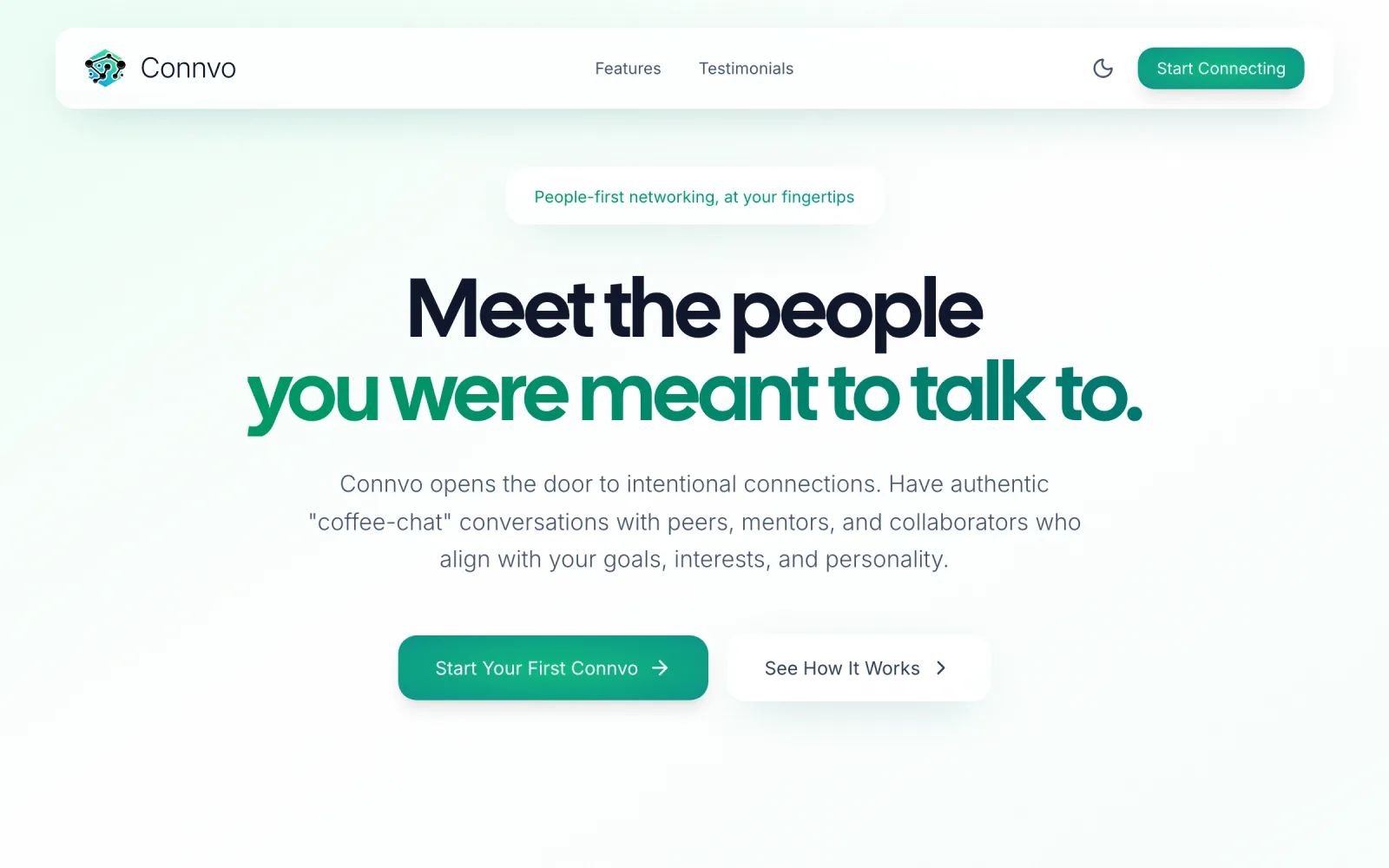
Connvo sets up one-on-one video coffee chats between people whose interests, goals and experience fit. You join a matching queue, it pairs you with someone and tells you why, and it hosts the call with shared notes and suggested prompts beside the video. I wrote most of its Convex backend, including the matching engine, and Andrew Wang built most of the Next.js front end. Its site is connvo.app.
How a pair gets scored
Connvo is built around one conversation at a time, so a match has to be worth showing up for, and both people should be able to see why it was made.
How a pair gets scored
The matching engine scores each pair on eight features, weighted by default like this:
- Shared interests, 25%
- Embedding similarity between the two profiles, 20%
- Experience gap, 15%, because a mentor and someone newer can both get something out of a chat
- Industry, time zone and language, 10% each
- Organization preferences and complementary roles, 5% each
The score comes back with plain-language reasons, such as “Strong interest alignment,” so the explanation travels with the match. The weights aren’t fixed. Accept, decline and completion outcomes feed an analysis that measures how well each feature predicts a successful match and proposes new weights from that.
You tell the queue when you’re free, and an entry expires on its own once that window passes. The queue is processed in shards, and match creation uses optimistic concurrency to prevent race conditions.
The rest of the backend
Convex holds the database, the server functions and the realtime subscriptions. The front end and backend share Zod schemas and generated TypeScript types, so both sides check against the same definitions. Sign-in runs on WorkOS AuthKit. Calls run on the Stream Video SDK, with a browser WebRTC fallback. Profiles are embedded with OpenAI for the similarity feature.
Access control lives in the backend too. Meeting data sits behind permission guards that check who’s in the meeting, and data access is written to an audit log. The API reference regenerates from docstrings on the Convex functions.
The git history shows the split with Andrew. Most commits under convex/ are mine, and most under src/ are his.
- Built with
- Links
