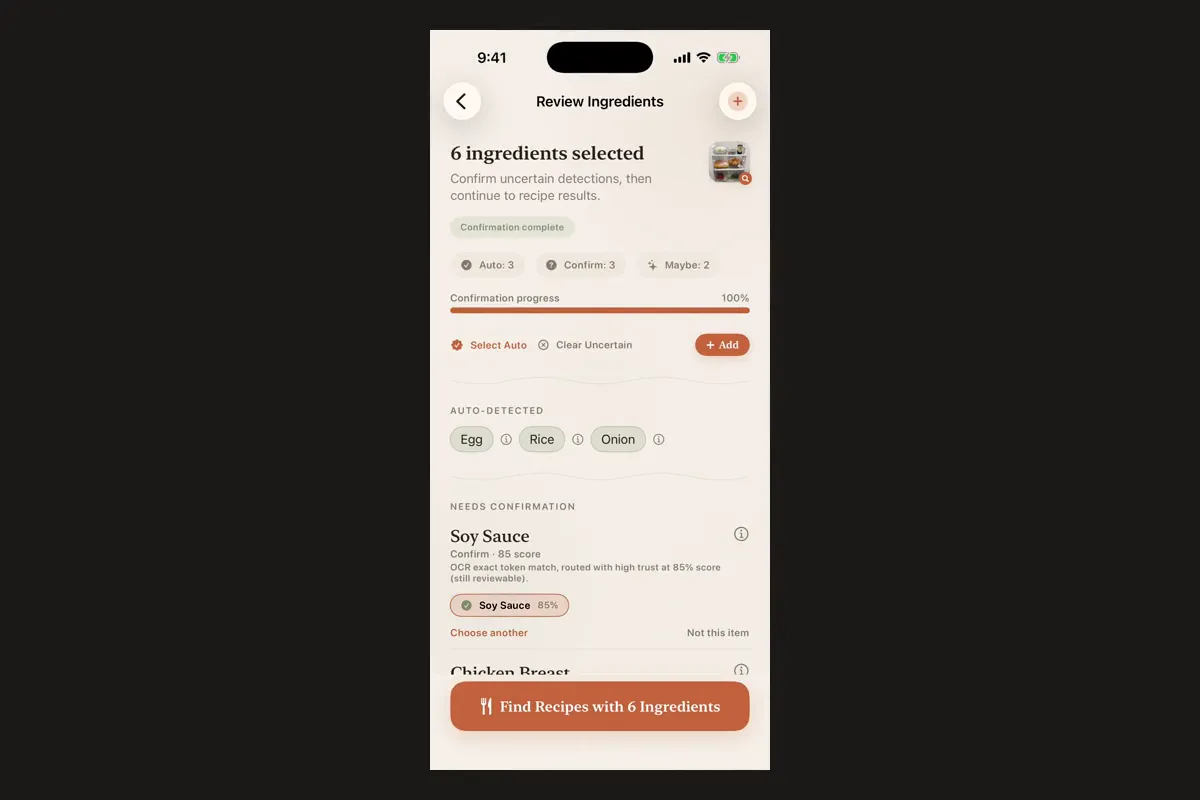
Potluck, but for your fridge. Snap your shelves for recipes, and it only asks about the items it isn’t sure it saw.
FridgeLuck is an iOS app that looks at your fridge, suggests what to cook and tracks what you eat. Apple Vision and OCR read the shelves on the device, Gemini Live looks at the whole scene, and a Bayesian confidence model decides which detections to trust and which to ask you about. I wrote most of it in Swift, and my poster on it won first place at UNT’s AI in Action competition.
What to trust, what to ask
The app’s own demo image and scan, in a kitchen drawn for this page, where your answers teach it nothing and the dials change only your view, since FridgeLuck reads a photo as it was taken. Its router adds a guess from the picture at 82% or more, asks about one from 45% and lists the rest as possible, but a label it reads needs 90%, so it asks about the soy sauce at 85% too.
What to trust, what to ask
Vision models guess wrong. A recipe app that trusts every guess tells you to cook with things you don’t have, and one that asks about every item makes you type your fridge in by hand. So each detection lands in one of three tiers. Confident items are confirmed automatically, middling ones get a quick question, and weak ones show up only as possible items.
At 85%, a picture guess is added on its own and a label read gets a question. In the demo, the soy sauce label was read at 85%.
The app’s own thresholds, with its demo scan’s eight detections where their scores put them. Drag the mark, or use the arrow keys, and the line under the ruler says what the app would do with a detection at that score, which it calls a routing score, not a calibrated chance of being right.Data table
Item
Read by
Score
What the app does
Egg
Picture guess
92%
Added on its own
Rice
Picture guess
88%
Added on its own
Soy sauce
Label read
85%
Gets a question
Chicken breast
Picture guess
58%
Gets a question
Onion
Picture guess
95%
Added on its own
Garlic
Picture guess
55%
Gets a question
Bell pepper
Picture guess
42%
Stays a maybe
Green onion
Picture guess
30%
Stays a maybe
The confidence comes from a small Bayesian learner I designed. Each kind of signal keeps a trust score shaped like a beta distribution, starting from a prior set by how reliable that signal tends to be, so an exact OCR match starts out trusted more than a fuzzy one. When you log a meal from a photo, the app records how its guess held up. Choosing its top recipe counts as a strong success, choosing a lower candidate counts for less, and picking a recipe by hand counts least. Those outcomes update the trust scores, so the model leans on whichever signals keep turning out right.
The app’s own priors for where each kind of signal’s trust starts, as a beta distribution, with an exact label read trusted most. When you log a meal from a photo, the app scores how its guess held up and moves each signal’s trust with that score, which the marks below the axis show for its top recipe, a lower one and one picked by hand, while a meal logged without choosing among its candidates scores 0.72.
Exact label read: trust 0.78 ± 0.13
00.51
Was the 85% guess right?
FridgeLuck’s own trust update, run on its own starting trust for three ways it reads food. The deeper fill is the trust plus or minus one standard deviation. Each answer is to a guess the app scored 85%, older answers fade by 0.3% a step, and in the app’s code the phone keeps the result between scans, but your answers here change only this page.
What’s in the app
A bundled cookbook of 166 recipes and an ingredient catalog of 800 foods built from USDA nutrition data, with 3,998 alternate names to match detections against.
Recipe generation and ranking with Gemini 2.5 Flash, grounded in the ingredients it photographed and in that catalog.
Meal logging from a photo of your plate, which matches the dish to a recipe and updates your inventory.
Apple Health sync for calories, protein, carbohydrates, fat, fiber, sugar and sodium.
A recipe ranking that learns from you, using your past star ratings, the cuisines you cook and a penalty for repeating the same dish.
Who built it
I wrote most of the app and designed the confidence model and the tiers it feeds. Shrey Suri and Andrew Wang also contributed to the repository. Afterward I wrote the confidence work up as a poster, “FridgeLuck: A Confidence-Aware Framework for Human-AI Collaboration in Food Waste Reduction,” and presented it myself at UNT in April 2026.